
You have probably tried being sensible. The cooler room. The earlier night. The phone ban. The magnesium. Possibly the podcast with the voice of someone who has never opened a council tax bill.
You made an effort and yet, there you are. Awake.
Not dramatically awake, not usefully awake. Just lying there, noticing the time, the sheets, the temperature, your partner’s breathing, tomorrow’s responsibilities and the deeply unfair fact that even sleep now seems to require an instruction manual.
This is where sleep advice can start to turn on you. What began as a helpful routine quietly becomes another job. Another thing to optimise, track, fix, improve and feel faintly judged by.
You are no longer going to bed. You are reporting for duty. And sleep, annoyingly, does not always arrive because you followed the instructions.
Why this feels different after 45
After 45, this can feel especially unfair. Sleep may already be lighter, hotter, more interrupted or more vulnerable to stress, pain, snoring, reflux, medication, alcohol or the needs of other people.
Your body may not shrug off bad nights the way it once did. Your responsibilities may not politely reduce themselves because you slept badly.
Then modern sleep culture comes along and suggests that, with enough discipline, data and herbal optimism, you should be able to manage the whole thing into submission.
That is a lot to ask of a tired person.
You may already care more than enough about sleep. That concern may have turned into the kind of vigilance that keeps your brain on duty.
Sleep has become another performance target
There is nothing wrong with caring about sleep. Poor sleep can affect mood, concentration, patience and the basic ability to reply to an email without sounding like you have been personally wronged.
The problem starts when caring turns into supervising.
You are not just winding down. You are checking whether you are winding down correctly. You are not just going to bed. You are assessing the conditions. You are not just waking in the night. You are gathering evidence that the whole system has failed.
Modern life has a way for turning basic human needs into projects. Eating becomes nutrition strategy. Walking becomes step optimisation. Rest becomes recovery protocol. Sleep, inevitably, becomes another thing to manage.
The sleep world now comes with apps, trackers, scores, supplements, routines, reels and firm little reminders that you are probably doing evenings wrong.
There is a name for the more extreme version of this: orthosomnia. It describes becoming overly preoccupied with achieving “correct” sleep, often through trackers and sleep data.
Most will not need a label but will recognise the feeling: waking up, checking a score and letting an app tell them how human they are allowed to feel that day.
Sleep data can describe a night. It cannot decide what you are capable of the next day.
The problem with trying to force sleep
Yes, sleep matters enormously, but it cannot be commanded.
You can prepare for it. You can make the room cooler, darker and quieter. You can keep a steadier rhythm. You can avoid making life harder with late caffeine, bright screens and a bedroom that looks like an office with pillows.
But you cannot simply decide to sleep harder. That is where people get caught. A bad night happens, because bodies are rude like that, and suddenly the whole thing feels personal.
Did I go to bed too late? Was the room too warm? Did I look at my phone for too long? Have I ruined tomorrow?
At that point the problem is no longer being awake. The problem is that being awake has become evidence.
Evidence that you failed. Evidence that tomorrow is ruined. Evidence that your body cannot be trusted. Evidence that bedtime now needs even tighter management.
That pressure can make the bed less like a place of rest and more like a nightly performance review.
Start here
Is this helping, or has it become another job?
Use this as a quick audit, not another thing to fail.
HELPFUL
You keep a rough bedtime rhythm.
Becoming another job
You panic if the routine slips.
HELPFUL
You dim the lights because it feels calming.
Becoming another job
You treat lighting like a sleep exam.
HELPFUL
You avoid late scrolling most nights.
Becoming another job
One phone check feels like a catastrophe.
HELPFUL
You notice what affects your sleep.
Becoming another job
You analyse every bad night like a crime scene.
HELPFUL
You use a tracker lightly.
Becoming another job
The sleep score decides your mood before breakfast.
GE note: If the habit makes you calmer, keep it. If it makes you feel watched, judged or makes you grade your sleep, simplify it.
The loop that keeps the problem going
A practical routine can slowly become a trap.
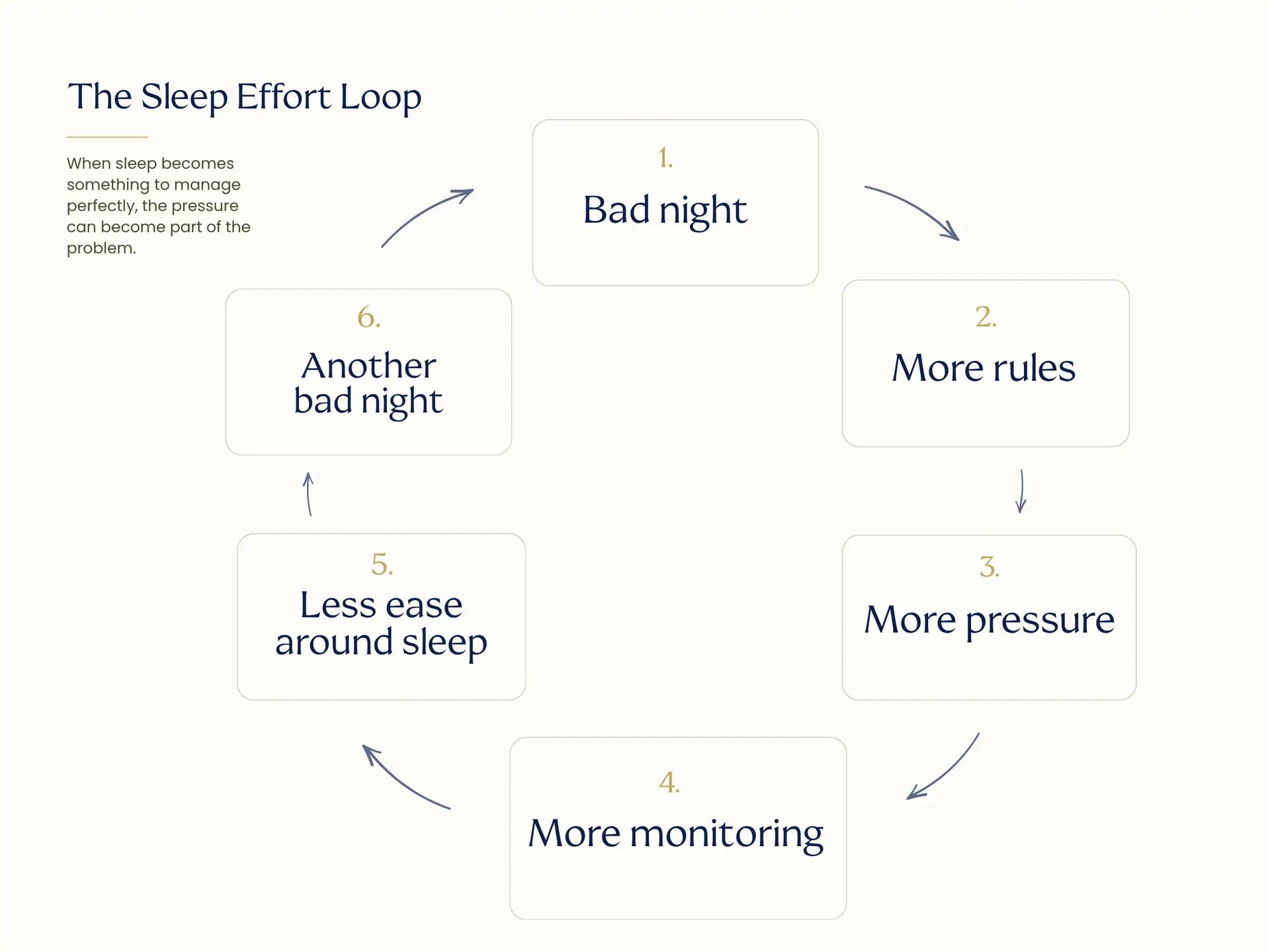
You sleep badly, so you add more rules. More rules make bedtime feel more important. The more important bedtime feels, the more closely you monitor yourself. The more closely you monitor yourself, the harder it is to drift off naturally.
Sleep starts to lose its ordinariness. Instead of being something your body moves towards, it becomes something you are trying to achieve under pressure.
This is why another candle, pillow spray or perfect bedtime sequence is not always the answer. Sometimes the room is fine, the pillow is fine and the routine is fine. Sometimes the problem is that sleep has become too important at the exact moment you need it to feel ordinary again.
This is also why proper insomnia support does not usually stop at “sleep hygiene”. CBT-I, widely recommended for chronic insomnia, looks at the thoughts, behaviours and patterns that keep sleep problems going.
In plain English: the answer is not always more rules. Sometimes the answer is changing the pattern around the rules.
What to stop doing at 2.43am
There are some things the half-awake brain should not be allowed to do.
It should not calculate how many hours are left before the alarm. It should not review your pension, your parenting, your blood pressure, your career choices and whether you came across badly in a meeting in 2017. It should not decide, in the dark, that tomorrow is ruined.
This is why clock-watching is so unhelpful. It turns wakefulness into a countdown. You are no longer resting. You are doing maths with consequences.
If you are awake, you are awake. Annoying, yes. A moral emergency, no. The aim is to lower the drama.
Not: I must get back to sleep immediately or tomorrow is a write-off.
More like: This is unpleasant, but not unusual. I can keep this boring.
Boring is underrated. Boring tells the brain there is no crisis here.
What to do instead
The answer is not to stop caring about sleep. It is to stop turning every night into a test you have to pass.
Start by making bedtime less impressive. A routine does not need to be a ceremony. It needs to be repeatable when you are tired, a little irritated and still wondering whether you replied to that message.
Keep it simple: wash, teeth, low light, something quiet, bed. Meditation, prayer, gentle reading or calm music can all help if they steady you. They become less helpful though, when they turn into another thing to perform correctly.
Keep one anchor habit if you can. For most people, a regular wake-up time is more useful than a perfect bedtime. It is boring advice, which is usually a sign that it has survived contact with reality.
The next step is to stop judging the night while you are still in it. No good verdict has ever been reached at 3.08am. Do not decide your health, marriage, future or competence while lying in the dark with one cold foot.
I do not need to solve this now.
This is not denial. It is basic night-time governance.
Keep the light low. Do not start scrolling. Do not check the time unless you genuinely need to. If you are wide awake and getting more wound up, get up briefly and do something dull until sleepiness returns.
The point is not to sit in a chair like a Victorian ghost. It is to stop turning the bed into a place where you practise frustration.
Most importantly, treat one bad night as one bad night. Not a diagnosis or a collapse of standards. Not proof that your pillow, personality and entire routine are underperforming. One bad night means you had one bad night. The calmer you can be about that, the less power the next bedtime has to become a test.
The “sleep is not my job” reset
Try this when bedtime has started to feel like a performance.
Tonight, I am not aiming for perfect sleep.
I am aiming for a calmer night.
I will create the conditions, then stop supervising the outcome.
If I wake up, I will not turn it into a trial.
No courtroom. No evidence. No dramatic sentencing.
If my brain starts holding a meeting, I will not attend every agenda item.
One imperfect night is allowed.
Tomorrow may be slower but it is not automatically ruined.
You do not need to win the night
You are allowed to care about sleep without turning it into a nightly assessment.
Make the room comfortable. Keep the routine simple. Be honest about caffeine, alcohol, stress, pain, snoring and screens. Get proper help if sleep problems are persistent, severe, sudden or affecting daily life.
But take some of the pressure off. You do not need to win the night. You do not need to rest perfectly.
Create the conditions. Stop managing the night.
For the nights when your brain starts holding a meeting at 3am
Keep the GE 3am Bedside Reset Card nearby. It is short, calm and designed for half-awake humans who do not need a full self-improvement programme in the middle of the night.
GE Editorial Note
How this article was made
Sources
This feature draws on current NHS and NICE insomnia guidance, the American Academy of Sleep Medicine’s guidance on behavioural treatments and peer-reviewed research on orthosomnia; the excessive pursuit of better sleep data that can increase sleep-related anxiety.
Scope
This article explores how pressure, monitoring and rigid sleep rules can make wakefulness feel harder. It provides general information rather than diagnosis or individual treatment advice. Persistent sleep problems, significant daytime effects or concerns about another health condition should be discussed with a GP.
Reviewed
Last reviewed August 2026. Health guidance, terminology, factual claims and outbound links were checked.
Imagery
AI-generated editorial illustration. It does not depict a real person or event.
Corrections
Found something that needs correcting? Read our Corrections policy or contact us.