

You have probably tried the polite sleep advice already.
A cooler room.
Less caffeine.
Less scrolling.
A more sensible bedtime.
Maybe herbal tea and a level of lavender optimism that deserved better results.
And sometimes those things help. But sometimes they do not.
That is when many people start assuming they are the problem. They must be doing sleep wrong. They must need more discipline, more calm, more supplements, a better pillow or somehow fewer responsibilities by bedtime. Well, not necessarily.
Sleep hygiene helps create the conditions for sleep. CBT-I looks at what can happen when sleep trouble becomes a pattern, not just a problem with the room, the routine or the last coffee. Your brain and body may have started to learn insomnia, which is unfair, but not unusual. CBT-I is designed to interrupt that pattern.
Sleep hygiene matters. It just does not do the whole job
Sleep hygiene is useful. A regular wake time, a cooler bedroom, less alcohol close to bed, less caffeine late in the day and a calmer evening routine all make sense. But they mostly deal with the setting.
By midlife, sleep is rarely just about bedtime. It can be tangled up with hormones, pain, stress, medication, caring responsibilities, work pressure and the reality of being the person who has to remember everything.
Sleep hygiene does not always deal with what happens after a run of bad nights, when bedtime starts to feel loaded and sleep starts to feel fragile.
You go to bed earlier because you are tired, stay in bed longer because you are desperate and lie there willing yourself to drift off. Then you check the time and start dreading the next night before the day is over.
Without meaning to, you end up teaching your brain that bed is a place for effort, frustration and clock watching. CBT-I works on that pattern.
Start here
This article may be relevant if:
- you have tried basic sleep advice and you are still struggling
- you spend long stretches awake in bed
- you go to bed early, lie in or nap to compensate
If this sounds familiar, “better sleep hygiene” may be too small an answer.
What CBT-I actually is
CBT-I stands for cognitive behavioural therapy for insomnia. The name is dry. The idea is useful.
In plain English, CBT-I is a structured way of treating insomnia by looking at the cycle that keeps it going. NICE recommends CBT-I as the first-line treatment for chronic insomnia in adults of any age, and says it typically includes behavioural approaches such as stimulus control and sleep restriction.
It works on behaviour and thinking. Not thinking in the vague “just be positive” sense. Thinking in the practical sense of what you believe about sleep, how you react when sleep goes badly and what habits grow around the problem. NHS guidance describes CBT as a talking therapy that helps people change how they think and act.
The reason it matters is simple: insomnia is not always just the absence of sleep. Often, it becomes a relationship with sleep. A tense one.
You stop trusting it. You start monitoring it. You start trying to control it. The more important it becomes, the harder it gets.
CBT-I aims to loosen that knot.
The insomnia loop
One bad night does not only leave you tired. It can change what you do next. And what you do next can make the next night harder.
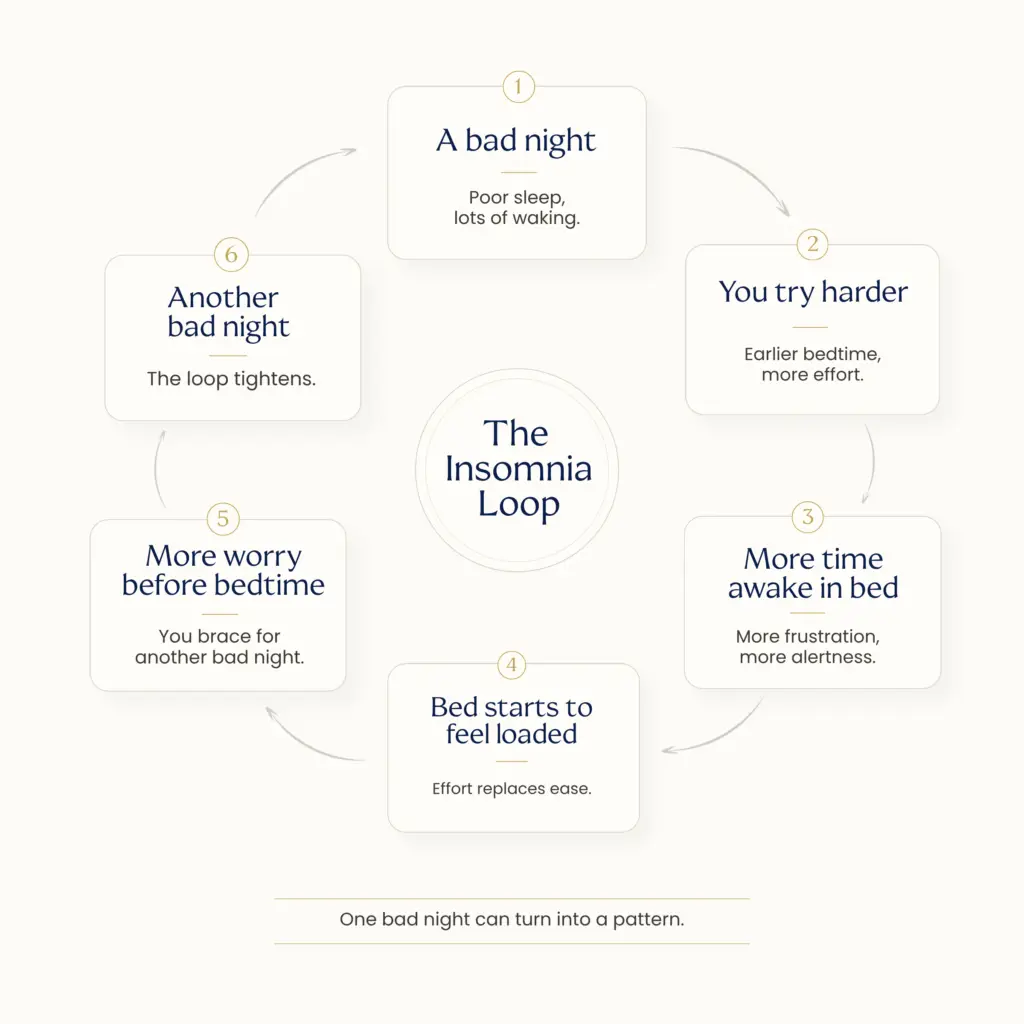
A hot room can start insomnia. Stress can start it. Hormones, pain or a difficult week can start it. But once insomnia becomes a loop, the original trigger is no longer the main issue. That is where CBT-I can be worth understanding.
What CBT-I may involve
CBT-I can include several techniques. The clearest way to understand them is to ask: what is each one trying to change?
It may help rebuild the link between bed and sleep, especially if bed has become a place for thinking, worrying and trying.
It may look at time in bed versus time asleep. This is where sleep restriction or sleep compression can come in. The names sound harsh, but the aim is to help sleep become more consolidated.
It may also work on the thoughts and habits that keep insomnia active: the fear of another bad night, napping “just in case”, staying in bed longer or organising the next day around the night before.
Those reactions make emotional sense. They can also keep the loop going.
Why CBT-I can feel counterintuitive
This needs saying plainly. Some parts of CBT-I sound strange when you are exhausted.
If you are exhausted, being advised not to go to bed earlier or stay in bed longer may sound ridiculous.
If you are awake, being told to get out of bed for a while may sound annoying.
If you are frightened of another bad night, being told to stop trying so hard can sound impossible.
And yet that is often why the approach is useful. It is not trying to comfort the insomnia loop. It is trying to break it. That is a different goal.
What is relieving about CBT-I
One of the most useful things about CBT-I is that it takes the pressure off your personality.
It does not assume you are lazy, undisciplined or secretly sabotaging yourself with bad bedtime choices. It looks at insomnia as a pattern that can be learned, reinforced and gradually changed.
That can be a relief if you have spent months, maybe even years, blaming yourself for not being calm enough, strict enough or tired enough to sleep properly.
The point is not to become a perfect sleeper. The point is to stop treating every bad night as evidence that you have failed.
What CBT-I is not
CBT-I is not sleep hygiene with better branding. It is not a warm bath, a darker room or one perfect night. And it is not something to aggressively DIY if there are signs of another sleep disorder, severe daytime sleepiness or health issues that need proper assessment first.
If you snore heavily, wake gasping, feel very sleepy in the daytime or think pain, hormones, menopause symptoms, medication, stress or another health issue may be involved, get medical advice rather than treating the whole thing like a willpower problem.
The NHS advises seeing a GP if sleep problems have lasted months, changing sleep habits has not helped or insomnia is affecting daily life. Sleep apnoea symptoms can include loud snoring, breathing stopping and starting, gasping or choking noises, waking often, daytime tiredness and poor concentration.
Make the next conversation easier
If poor sleep has become a pattern, it can help to have the basics written down before you speak to a GP or sleep professional. The Generation Everything Sleep Pattern Notes page gives you a simple way to record what is happening without turning sleep into another project.
Free PDF. Designed to help you explain the pattern clearly.
The real point
The GE version is this:
Sleep hygiene sets the stage. CBT-I works on the pattern.
If insomnia has become a loop of bad nights, extra effort, more worry and less trust in sleep, the answer may not be more candles, stricter rules or another article telling you to put your phone away.
A bad night is not a moral event. CBT-I is not about becoming perfect at sleep. It is about helping your brain stop treating bed like a place for battle.
That is a much more useful goal.
GE Editorial Note
How this article was made
Sources
This guide draws on NHS, NICE and specialist sleep-medicine guidance about chronic insomnia, CBT-I, sleep apnoea and the limits of sleep hygiene when used alone.
Scope
This article explains the principles of CBT-I but is not an individual treatment programme. Speak to a GP or qualified sleep professional if insomnia has continued for months or is affecting everyday life.
Reviewed
Last reviewed August 2026. Clinical guidance, treatment descriptions and outbound links were checked.
Imagery
AI-generated editorial illustration. It does not depict a real person or event.
Corrections
Found something that needs correcting? Read our Corrections policy or contact us.