

Not every tired brain wants silence. Some want a walk. Some want television. Some want a bath, a book or dinner that barely requires chopping.
And some want to pressure-wash a virtual patio until a small satisfaction meter confirms that progress is still possible, somewhere.
Relaxing video games are widely described as “cosy”, but that word has become too broad to be useful. Cosy now covers everything from farms and cats to cafés, cottages and tiny villages. What matters after work is not whether a game looks gentle. It is what kind of rest it offers.
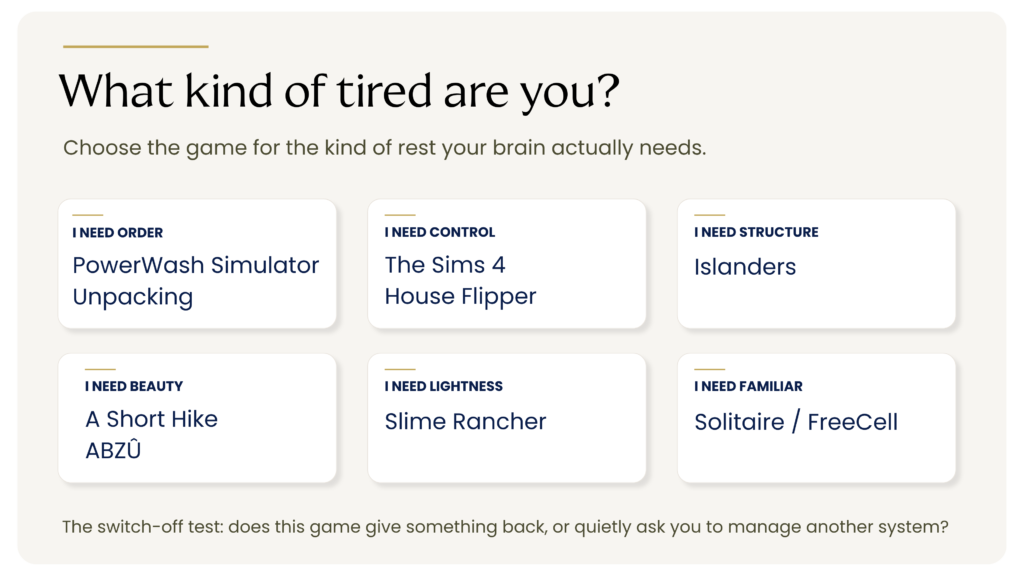
A tired brain looking for order needs a different game from a tired brain looking for beauty, lightness, control or one familiar puzzle before bed.
Unlike scrolling, a good relaxing game gives you agency. You do one small thing, see one small result and feel your attention settle.
The right game gives your brain somewhere gentle to land. The wrong one turns your evening into another shift.
Start here: the switch off test
- A good after work game should not feel like opening another inbox.
- Look for low stakes, simple controls, clear stopping points, calm sound and small satisfaction.
- Be careful with games built around constant alerts, daily streaks, leaderboards, complicated systems or the seductive pull of “just one more go”.
- The switch off test is simple: does this game give something back, or does it quietly ask you to manage another system?
When you need visible progress
Some evenings, relaxation is not doing nothing. It is being handed a mess that actually lets you fix it.
That is why PowerWash Simulator works so well. It is almost comically literal: dirty thing becomes clean thing. No grand mission. No complicated backstory. Just you, your tools and a filthy job slowly becoming respectable.
For anyone whose working day involved vague problems, invisible labour or unresolved messages, that clarity can feel deeply satisfying. You can see the progress. You can finish a job. Nobody moves the goalposts halfway through.
House Flipper scratches a similar itch, but with more domestic fantasy. In the real world, renovation means dust, quotes, delays and surprise costs. In House Flipper, you just get the pleasing bit: clean the room, fix the walls, choose the furniture and make the place behave itself.
Then there is Unpacking, which is quieter and more emotionally intelligent. It is about pulling possessions out of boxes and fitting them into new homes. The pleasure is not organising. It is noticing.
A mug. A book. A childhood object. A room that changes as a life changes. Unpacking works because it turns domestic detail into storytelling. You are not saving a kingdom. You are putting things where they belong and gradually understanding the person they belong to.
These games suit the kind of tired that wants proof: something can be cleaned, repaired, arranged or finished.
When you want to control a tiny domestic universe
There is another version of visible progress that is less about cleaning and more about control: making a small domestic world behave better than the real one.
The Sims 4 belongs here, but with a warning.
Played gently, The Sims can be wonderful after work. Build the kitchen. Fix the lighting. Give someone a calmer life than the one currently available in your actual laundry basket. It is a doll’s house for grown-ups.
Played intensely, it becomes life admin with better wallpaper.
Use it for creativity, decorating and low-stakes domestic control. Step away when it starts to feel like running another household.
When you want gentle control, not another inbox
Some people relax by switching off. Others relax by making a small world behave.
For that mood, Islanders is elegant and compact. It gives you minimalist city building without the heavy admin of more demanding strategy games. Place a building. Improve the island. Watch the shape develop.
Islanders is for the part of your brain that wants structure without a spreadsheet.
It is also a useful reminder that control does not have to mean complexity. A relaxing game can still ask you to make choices. It just should not make those choices feel like another meeting in disguise.
When your brain needs beauty and no one talking
Some games are relaxing because they stop asking you to process more words.
A Short Hike gives you a peaceful mountainside park to move through in your own time. You can follow the trail or wander off, meet characters, find small treasures and head towards the summit when you feel like it.
It is small in the best way. It does not try to take over your life. It gives you a place to move through quietly.
ABZÛ offers a different kind of escape: underwater movement, colour, marine life and the feeling of drifting away from the day. It is not a game for ticking things off. It is a game for lowering your shoulders.
These are useful games when the day has been too verbal. Too many calls. Too many messages. Too many people asking for “a quick steer”. Sometimes the most restorative thing a game can offer is motion without conversation.
When you need lightness
There is a particular relief in a game that refuses to be respectable.
Slime Rancher is bright, odd and playful. You collect and care for cheerful slimes in a world that asks very little of your serious adult self.
The value here is not childish escape. It is lightness. After a day spent being competent, responsive and sensible, there is something restorative about a game that does not ask you to be impressive.
The only caution is that even cute games can become task lists. If you find yourself optimising slime production after a long day, check whether you are relaxing or doing logistics in a nicer colour palette.
When you want one familiar little reset
There is a reason Solitaire has survived every era of technology.
It asks just enough of the brain without asking you to become a different person. No lore to absorb. No systems to learn. Just cards, order and a familiar little problem.
Solitaire, FreeCell and Spider Solitaire work best as small resets. One round. Maybe two. Enough structure to occupy the mind, but not enough to take over the evening.
Watch out for daily challenges, streaks and leaderboards. Once a quiet card game starts feeling like performance management, it loses the point.
The slow-life trap
The games that look calm are not always the games that feel calm.
A beautiful farm, a cute town or a gentle routine can still ask for planning, remembering, optimising and checking in.
Coral Island is a warm farm and life-simulation game about island living, farming, animals and relationships. It looks like exactly the kind of game that should soothe a tired adult. And it can.
But farming games have a habit of quietly becoming systems. Crops. Animals. Crafting. Gifts. Upgrades. Seasons. Schedules. Suddenly your relaxing evening involves remembering whether your digital cow has had enough attention.
This does not make Coral Island a bad choice. It may simply be a better weekend choice than a late Wednesday night choice.
Before choosing a game that looks cosy, use the switch off test. If it wants gentle attention, lovely. If it wants planning, optimisation and emotional labour with villagers, save it for when you have more capacity.
Quick guide: what kind of tired are you?
| If you feel… | Try… |
|---|---|
| Mentally cluttered | PowerWash Simulator |
| Fed up with real world mess | House Flipper |
| In need of quiet order | Unpacking |
| Domestic but creative | The Sims 4 |
| Strategic but tired | Islanders |
| Restless | A Short Hike |
| Overstimulated | ABZÛ |
| Tired of being sensible | Slime Rancher |
| Too tired to learn rules | Solitaire / FreeCell |
| Tempted by slow living | Coral Island |
How to keep relaxing games actually relaxing
- Choose the game before you sit down. Otherwise you may spend 40 minutes browsing and call it leisure.
- Set a stopping point: one house, one walk, one puzzle, one round. Ignore leaderboards when tired. Stop when you feel satisfied, not when the game runs out of things to offer.
- The aim is not to become a better gamer. The aim is to arrive back in your own evening.
Relaxing games are not about pretending adulthood has disappeared. It will still be there: the bills, the dishwasher, the family WhatsApp group and whatever arrives tomorrow.
The point is not to escape adulthood. The point is to choose a small piece of attention that gives something back.
For half an hour, that can be enough: low stakes, kind music and nobody needing a reply by close of play.
GE Editorial Note
How this article was made
Sources
Official developer and publisher pages were used to check each game’s description and current availability.
View sources and further reading
PowerWash Simulator
House Flipper
Unpacking
The Sims 4
ISLANDERS
A Short Hike
ABZÛ
Slime Rancher
Microsoft Solitaire Collection
Coral Island
Selection
Games were selected editorially for their pace, low stakes, manageable controls and natural stopping points. “Relaxing” is subjective rather than a health claim. No developer paid to be included.
Reviewed
Last reviewed August 2026. Game descriptions, availability and outbound links were checked.
Imagery
AI-generated editorial illustration. It does not depict a real person or event.
Corrections
Found something that needs correcting? Read our Corrections policy or contact us.