

Would your kids give your parenting 5 stars?
Not because you need a standing ovation but because the “reviews” (their memories) shape how they relate to you now. Now see which parenting style you leaned toward and learn how to reconnect with humour and heart.
You did it. Raised tiny humans into functioning adults while surviving the tantrums and curfews. The question now is… If your adult child wrote a review of growing up with you…. what would it say?
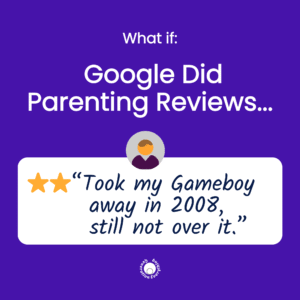
Is parenting… reviewable?
Not in a “leave feedback on Trustpilot” way (please no). But in a parenting is messy and your relationship with your child is the actual prize way. Honest reflecting can help you: spot what worked, own what didn’t and reconnect without the drama.
⚠️Quick note before we go further:
If your family history includes abuse, addiction or estrangement, skip the rating metaphor and go straight to the support section. This post is for everyday messy families trying to reconnect, not extreme harm.
✅ Rapid answer (30 seconds)
For a better relationship with your adult child, focus on these 4 moves:
- Ask what landed well and what didn’t
- Listen without defending your whole life story
- Own one thing you’d do differently
- Repair with small consistent effort, not one dramatic speech.
For the quick moves and the why? Let’s zoom out.
This is a light-hearted, slightly awkward, totally useful look at parenting styles through the eyes of your kids as they age. Caution: There are no perfect scores, just parents wanting to know how or even if those life lessons landed.
So, let’s learn exactly what kind of parent you were… really?
The Big 4 parenting styles (As Your Child Remembers Them)
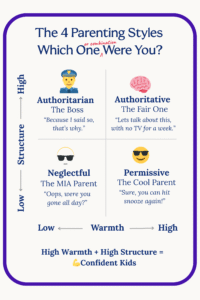
Psychologists break parenting into four main styles: authoritative, authoritarian, permissive and neglectful/uninvolved. Your kids remember them more like: “fair parent”, “unfair parent” and “the one that let them eat cake for breakfast”.
Here’s how styles tend to feel at 7, 15 and 25 years old.
1. Authoritative parenting (AKA: “The Fair one”)
High warmth + high structure
This is the kind AND consistent style most people secretly wish they had.
- Age 7: “Mum listens to my stories, but she still makes me eat vegetables. Betrayal.”
- Age 15: “They want to talk to me about my feelings. It’s so embarrassing.”
- Age 25: “Oops. They actually knew what they were doing. I owe them an apology.”
Your vibe:
- You set clear rules and were loving and supportive.
- You actually let your kids have an opinion (even dramatic teenage ones).
- You balanced discipline with responsibility.
Tends to be associated with: adults that have healthy self-esteem, do well in school and have better emotional regulation (Baumrind, 1991).
2. Authoritarian parenting (AKA: “The Boss”)
Low warmth + high structure
This creates obedience… and sometimes emotional distance.
- Age 7: “There are soooo many rules. I can’t eat snacks without permission.”
- Age 15: “Why is everything a courtroom??”
- Age 25: “I was well behaved… but second-guessing everything.”
Your vibe:
- Your rules were non-negotiable.
- You expected obedience, not debates.
- Your child’s opinion? Cute, but irrelevant.
Tends to be associated with: well-behaved kids but who can have anxiety and low self-esteem (Lamborn et al., 1991). i.e. A lifelong fear of asking for extra ketchup at McDonald’s.
3. Permissive parenting (AKA: “The Cool parent”)
High warmth + low structure
Fun in childhood, messier in adulthood.
- Age 7: “If I want ice cream for breakfast, my mum laughs and hands me a spoon”
- Age 15: “I can set my own rules. But … I kinda need guidance, only learning by my mistakes can be painful – literally!”
- Age 25: “Nobody ever taught me how to budget or do laundry. Send help.”
Your vibe:
- You avoided conflict and tough talks
- You’re more of a friend than a parent
- Rules? More like suggestions
Tends to be associated with: creative, independent kids but also ones who may struggle with self-discipline, boundaries and hearing the word ‘no’ (Maccoby & Martin, 1983).
4. Neglectful / uninvolved parenting (AKA: “I raised myself”)
Low warmth + low structure
This one’s tough, sometimes it wasn’t “neglect”, it was survival. Stress, burnout or your own upbringing can make showing up hard.
- Age 7: “I make my own lunch. No one checks my homework. I think they genuinely forget they have a kid in the house.”
- Age 15: “I can do what I want, but … I wish someone cared enough to stop me.”
- Age 25: “I had to teach myself everything. Emotions? Never met her”
If this hits a nerve, compassion helps more than guilt. The good news is that repair is possible, especially if you can name what happened and show up differently now.
Tends to be associated with: serious emotional and social consequences leading to attachment issues and struggles with self-regulation (Bowlby, 1988).
Ultimately your style influenced how it felt to be your child and that affects how they relate to you now.
Why reviews change as they grow
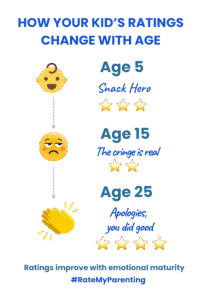
At age 5, you’re rated on:
- Snack availability
- Screen time rules
- Lost toy retrieval speed
At age 15, you’re rated on:
- Whether you embarrass them in public
- If you let them go out without asking 100 questions
- If you understand the concept of “just five more minutes”
At age 25, you’re rated on:
- How well you prepared them for adulthood
- If they can call you for advice without being judged
- Whether you still pay for things (their question, not yours).
This is why parenting feels like a moving target: the job description changes and nobody tells you.
Why you parented the way you did
Ok, so your little person didn’t pop out with a manual, yet every parent starts with a blueprint. Your parenting style was shaped by:
- Your own childhood
- Culture and tradition
- Stress & circumstances
- Personality & temperament
Remember: in some cultures, “strict” = “caring”. In others “strict” = “fear”. Context matters.
If your childhood was a mess, you don’t have to pass it down like a dodgy family heirloom. Understanding your blueprint gives you the power to snip the bad bits and repeat the good stuff.
The Repair Toolkit: Reconnect without the drama
When your kids become adults you’re no longer in charge, you’re a relationship partner. Try these conversation starters:
- “I think I was stricter than I meant to be, how did that feel for you?”
- “What did you need more of growing up?”
- “Is there anything you want us to do differently now?”
- “Can we start this talk again, with more honesty this time?”
Rules: Listen more than you defend & curiosity beats perfection.
Why humour is your secret weapon (if you use it right)
Humour in parenting (especially with adult children) works better than a lecture and is less frightening than “we need to talk.”
The key is to laugh with, not at your loved one and early evidence suggests: laughter = closeness (It softens tension and builds connection) (Emery, et al 2024).
Try replacing: “you always overreact” with “cue dramatic violin music…”
Plus, nobody rolls their eyes mid-giggle.
Quick self-check: Would you give yourself a parenting award? Or … a participation medal?
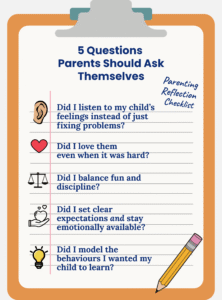
If “yes” to most, you’re winning. Honest reflection with gentle repair is more powerful than any rating.
Reality check: When researchers compare both sides, parents typically rate their warmth/support and rule setting more positively than their children do (Korelitz & Garber, 2016) so don’t be afraid to double check.
Final thoughts: Parenting isn’t about being perfect, it’s a relationship
If parenting had ratings, most of us would bounce between five stars and “needs improvement” depending on the day. What matters is you’re still willing to learn and show up.
Your turn: Ask (without making it a test)
- “I’ve been thinking about how I showed up as a parent. I’m not looking for praise or an argument, I just want to understand you.”
- “What helped?”
- “And what do you want from me now?”
Then listen. No defending. The fact you’re even asking is key.
Want a calmer way to start this?
Download the Review of your parenting (keep it private). If you comment here, share your reflections not their answers.

#RateMyParenting #ParentingHumour #FamilyConnection
Support (if things are strained)
If your family situation is complicated, these can help:
- Family-Action – Free helpline
- Standalone – Support for estranged families
- Counselling Directory
- Relate – Family Therapy
- BACP – British Association for Counselling and Psychotherapy
Still helping out financially? Try the Free Family Budget Template before lending money again. Also helps to set healthy boundaries and expectations.
Watch: Doc Snipes – 10 strategies for overcoming childhood neglect
Recommended reads:
- The Whole-Brain Child: Dr Daniel Siegel & Dr Tina Payne Bryson (for the nerdy cool parent)
- Adult Children of Emotionally Immature Parents: Lindsay Gaibson
Academic sources:
Baumrind, D. (1991). The influence of Parenting Style on Adolescent Competence and Substance Use. Journal of Early Adolescence.
Lamborn, S. D., Mounts, N. S., Steinberg, L. & Dornbusch, S. M. (1991). Patterns of competence and adjustment among adolescents from authoritative , authoritarian, indulgent and neglectful families. Child Development, 62(5), 1049-1065.
Maccoby, E. E., & Martin, J. A. (1983): Socialization in the Context of the Family-Child Interaction.
Bowlby, J. (1988). A Secure Base: Parent-Child Attachment and Healthy Human Development. London: Routledge.
Emery,L., Libera, A., Lehman, E., Levi, B. (2024). Humour in parenting: Does it have a role? PLOS One.